
The “psychology of wealth” (commonly referred to as wealth psychology or financial psychology) is a widely recognised field that studies how human emotions, upbringing, biases, and beliefs dictate financial behaviour. It explores why people make highly irrational decisions about money, proving that doing well as far as money is concerned, is less about what you know and much more about how you behave.
Of adults all over the world, only 1,5% have wealth (net assets) of $1M+. If you follow social media, you might feel that that number is closer to 100%. The following graph shows the results of 56 markets analysed by UBS, with a total adult population of ~3.8 billion in 2025.
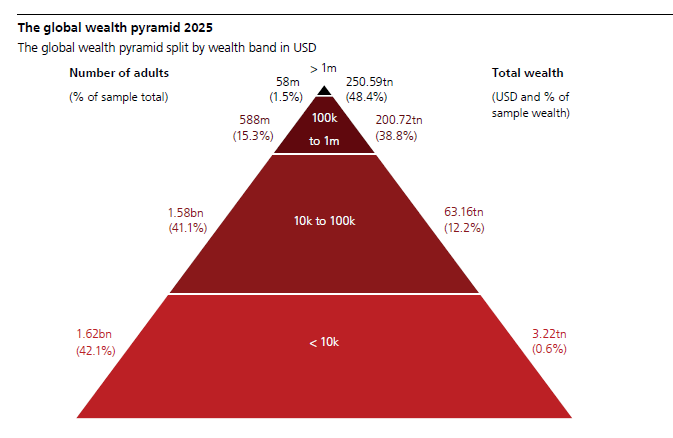
It must be said that having net assets means that you have no debt (assets minus debt = net assets). 83% of the adults in the study have less than $100 000, probably tied up in the property they live in. It is clear that people spend what they earn. If you are one of the people who focus on increasing their wealth, either because you are able to do so or because your personality drives you to do so, you are in the minority. There is another, very powerful definition of wealth not covered by this study and that is not wanting more than you can afford.
If you find yourself in a position where you have to scale down your wants to a situation where you can only have what you need, you might be surprised by how quickly you can adapt to a life where you live closer to your actual needs. At the end of the day wealth should not only be measured by net assets, but also by being happy with what you have.