
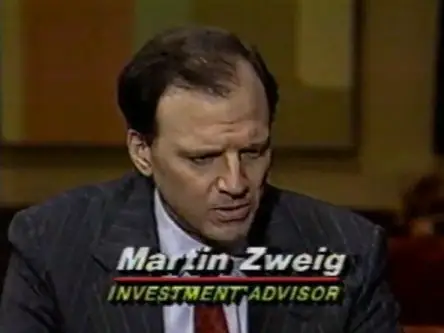
Martin “Marty” Zweig (1942–2013) was an American investor, financial analyst and author who became one of Wall Street’s most respected market commentators during the 1980’s and 1990’s. He published The Zweig Forecast for 26 years and authored Winning on Wall Street, a book that outlined his investment philosophy and approach to analysing financial markets.
Zweig is perhaps best remembered for his warning ahead of the ’87 stock market crash, known as Black Monday. During a television appearance just three days before the crash, he expressed concern about an impending sharp market decline – a call that cemented his reputation as a perceptive market analyst.
Whether you are an investor in unit trusts, exchange traded funds (ETFs), retirement annuities, living annuities, direct equities, or almost anything else, there are certain investment rules most money managers pay attention to. Zweig’s investment rules remain significant today because they distil years of market research and experience into practical principles for making investment decisions. Rather than relying on instinct or attempting to predict every market movement, he emphasised the importance of evidence, market trends, investor sentiment and disciplined decision-making.
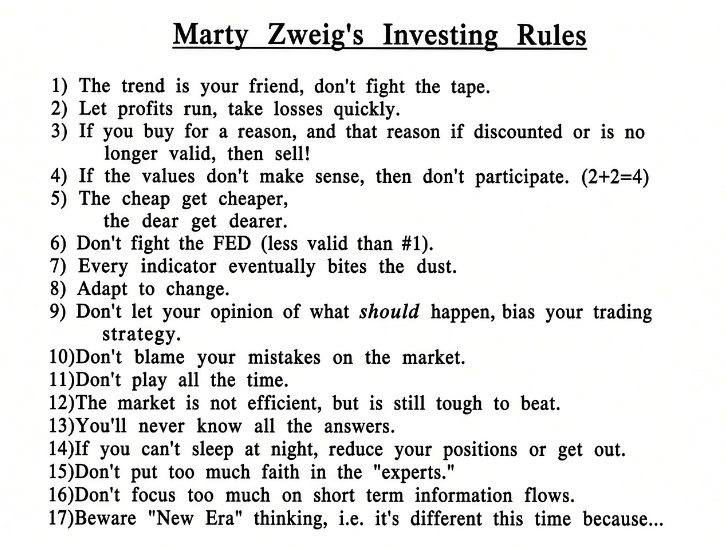
Let’s take a closer look:
- The trend is your friend, don’t fight the tape. – When you are investing in an asset class, usually shares, don’t try to anticipate a change in the current momentum. If the markets are going up, don’t sell because you think it has gone up too much, and vice versa when shares are going down.
- Let profits run, take losses quickly. – If you invest in something and it is making you money, keep it; but if your investment is not performing, don’t be emotional and hope it will turn around, sell it.
- If you buy for a reason, and that reason if discounted or is no longer valid, then sell! – Don’t forget to evaluate your investments regularly.
- If the values don’t make sense, then don’t participate. (2+2=4) – Another way of saying this is, “If it seems too good to be true, it usually is.”
- The cheap get cheaper, the dear get dearer. – Good investments will never become cheap, there is a reason why they are expensive and vice versa.
- Don’t fight the FED (less valid than #1). – The “Fed” refers to the Federal Reserve in the U.S. They determine the interest rates and we know that when they increase the rates, investments do poorly and vice versa. As an investor you might think that the Fed is wrong to increase or decrease interest rates at a specific time and therefore ignore them; but you will most likely be the one making a mistake.
- Every indicator eventually bites the dust. – If you use technical indicators like P/E ratio (price earnings ratio), RSI (relative strength index), etc., they might work for a while but they are not always accurate indicators of a good or bad time to invest.
- Adapt to change. We are currently living in one of those periods of change. Many investors try to compare current valuations of big tech companies to the dot com bubble of 1999/2000, ignoring the fundamental differences between then and now.
- Don’t let your opinion of what should happen, bias your trading strategy. – This is another mistake many money managers are making currently. If you haven’t been invested in the big tech companies in the U.S. over the last five years because you thought they were overvalued and should come down, your investment strategy has backfired and you have missed out on a generational wealth creation opportunity.
- Don’t blame your mistakes on the market. – The market is not against you, it is just doing what it does and you have to take responsibility for your own investment mistakes.
- Don’t play all the time. – It is okay to wait in cash if you don’t see any investment opportunities.
- The market is not efficient, but is still tough to beat. – The majority of money managers don’t outperform the indices because all the information that could move the prices of shares is instantly available to everyone at the same time. Very rarely do you get an opportunity to identify something other investors haven’t picked up on.
- You’ll never know all the answers. – We always think we know best, but we don’t. Have an open mind and listen to people who disagree with you.
- If you can’t sleep at night, reduce your positions or get out. – It is not worth taking on more risk than you can emotionally be comfortable with. We all have different personalities and you have to invest accordingly.
- Don’t put too much faith in the “experts.” – Everyone on social media pretends to be an “expert”. Rather do your own research and be very selective about who you take advice from.
- Don’t focus too much on short term information flows. – We are bombarded with information every second of the day. The majority of it can have a very short-term impact on investment values. Make investment decisions based on information that will change the longer-term investment outcome.
- Beware “New Era” thinking, i.e. it’s different this time because… – Most investment fundamentals will result in the same outcomes for investment values. If we take gold as an example; if it goes up a lot over a short period of time, don’t think that it is suddenly a non-cyclical commodity. It is still something that has no yield, no earnings potential and no way of fundamental valuation.
Zwieg’s rules are a reminder that ultimately, successful investing is not about getting every decision right but rather having a clear strategy, recognising when the facts change and most importantly, keeping your emotions in check.