
We have seen a very clear divergence between the S&P500 index performance in the USA and the Emerging Market index over the last five years. The 5-year annualized total return (USD) of the S&P500 was 16% compared to a 9% return for the MSCI Emerging Markets Index. This is a significant outperformance by the S&P500 and we have to ask why. While a roughly 9% annualized return for emerging markets is relatively healthy historically, it has lagged behind the exceptional secular bull run of the S&P500, which has benefited heavily from U.S. dominance in artificial intelligence, cloud computing, and digital platforms. Emerging markets tend to experience sharper cyclical swings and prolonged consolidation periods – such as regulatory pressures and real estate headwinds in China over the first half of the decade – which weigh on multi-year annualized averages despite periods of strong short-term rallies.
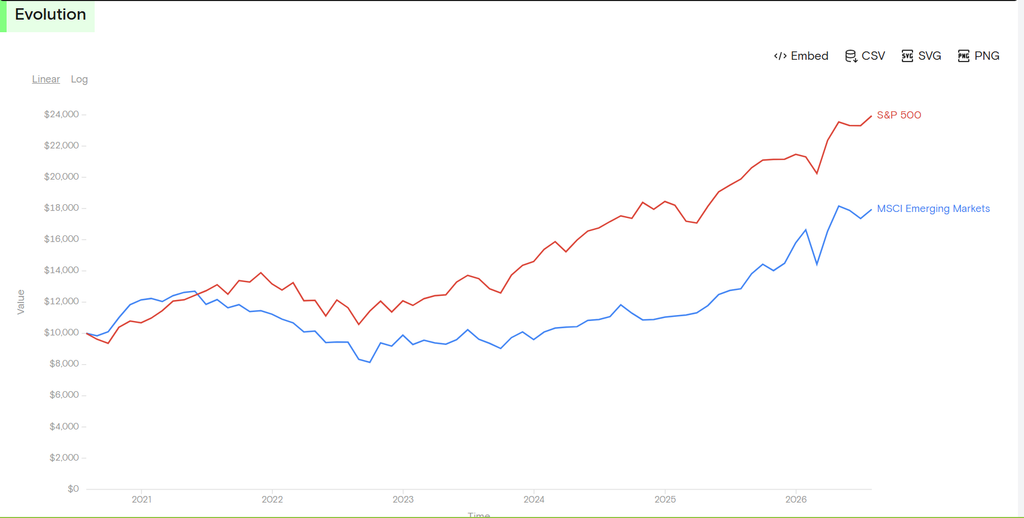
So what do you buy when you invest in the MSCI Emerging Markets Index?
- China: ~27.6%
- Taiwan: ~20.6%
- India: ~15.3%
- South Korea: ~13.3%
- Saudi Arabia: ~3.8%
- Brazil: (typically ranges between 4% to 5%)
- South Africa: ~2.9%
- Other: ~11.5%
The biggest detractor of performance has been China, which contributed only 1.9% per annum over a 5-year period. This is very frustrating because there are well established technology companies in China which mirror the business models of some of the more successful companies in the USA. As an example we can look at a company called Baidu which is the equivalent of Google in the USA. Over the last five years Google delivered a return of 160% compared to Baidu with a return of only 48%. Baidu shares several core pillars with Google:
- Core Search Engine: It operates China’s dominant internet search engine, capturing the vast majority of the domestic search market.
- Advertising-Driven Revenue: Like Google, the bulk of Baidu’s financial revenue is generated through pay-per-click (PPC) and targeted keyword advertising.
- Ecosystem Expansion: Both companies stretch far beyond simple web queries into similar verticals, including online maps, cloud services, and hardware.
- Artificial Intelligence: Both companies heavily prioritize AI development, with Baidu heavily investing in autonomous driving technology (Baidu Apollo) and large language foundation models.
Another company that we all should know is Tencent. The 5-year performance has been only 7.5%, translating into the underperformance of our JSE-listed Naspers which averaged a dollar performance of only 5% per year over the last five years. The popular narrative in the market is that the Emerging Market sector is undervalued and offers a good alternative to investing in the S&P500 index. This might be true if we look at the spectacular moves we saw in the SA market last year due to the rally in Gold and other commodities and the 7.7% one-day jump in the Brazilian index when it became clear that the business-friendly Flavio Bolsonaro had finished ahead of Lula in the first round of the presidential election.
The problem with this expectation is the question about what would change the current mindset of the Chinese government to become more business-friendly; as well as the fact that one of the biggest contributors to the Taiwanese index is a semiconductor company called TSMC and two memory chip companies called Samsung and SK Hynix in South Korea. If the performance of the Big Tech companies slow down and investors start looking for something else to invest in, they will surely not go to South Korea or Taiwan because these indices will also fall under the Big Tech slowdown.
The conclusion is that the U.S. market has outperformed owing to their dominance in AI and Big Tech. There will surely be a slowdown in the earnings growth of these companies in the years to come; but when investors start looking for alternatives, will China, Taiwan and South Korea offer an alternative if their markets are also driven by Big Tech? Perhaps we will see the low valuations of Big Tech companies in China become so compelling that the potential interference by government gets moved to the sideline; or markets like India and Brazil take up the slack created by tech-dominated countries like Taiwan and South Korea when the Big Tech boom winds down.